This research automates the detection of long QT syndrome (LQTS) – a symptomless heart condition caused by many common medications that can lead to sudden death. To do this, it uses artificial intelligence that is fully ‘explainable’, and intuitively understandable by lay people.
We take a completely new approach to ECG interpretation, which will ultimately allow people to monitor for serious heart conditions at home.
Interpreting ECGs takes years of training. Measuring the QT interval is particularly hard, due to the challenges associated with determining the precise start and the end of the ECG waves, which differ considerably in their characteristics across individuals. The issue is compounded by the fact that the QT interval is presented horizontally, and humans find it difficult to perceive quantity in this direction.
Our approach
Our multidisciplinary team combined knowledge from psychology, medicine and computer science to produce an algorithm that works with >90% accuracy and is easily understood by both clinicians and lay people, as it can be visualised using a spectrum of colour superimposed on the ECG signal (see example below). The colour on the ECG shows quickly whether a person is at risk of sudden cardiac death — the warmer the colours (yellow, orange, red) the greater the risk.

Patient A shows a normal QT interval, at a slow (top) and fast (bottom) heart rate.
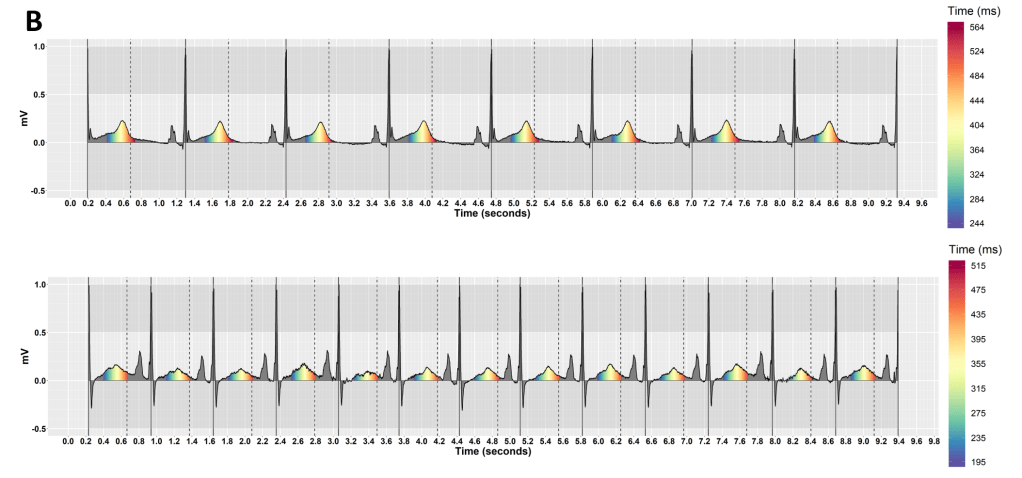
Patient B shows a prolonged QT, at a slow (top) and fast (bottom) heart rate. Patient B is at risk of sudden cardiac death.
Explainable AI
To create the technology, we challenged ourselves to think completely outside current approaches to ECG interpretation – both medical and computerised. Manual ECG interpretation requires laborious and difficult measurement of the ECG waveform. Current automated ECG interpretation relies on ‘black box’ algorithms that require vast amounts of training data and can’t explain how they produce their results. We were inspired by studying how humans perceive colour and signal data, and used this as the foundation of our model. Both the computer and the human interpreter share the same representation of the data, engendering trust in the resulting technology. This means that our automated interpretation – which provides a rapid judgement of the risk of sudden cardiac death – is completely explainable to clinicians, and can also be understood by lay people. A patient focus group said it “could lead to a culture shift, transforming the way health care works within the NHS”.
Mobile applications
We have prototyped the approach for mobile technology, which will allow people to self-monitor for LQTS. This is particularly important when starting new treatments, or taking part in clinical trials, as LQTS can be caused by many common medications, including anti-depressants and cancer drugs.
The approach also has the potential to transform cardiac monitoring in lower income countries, as it has a vastly lower cost in terms of both equipment and training.
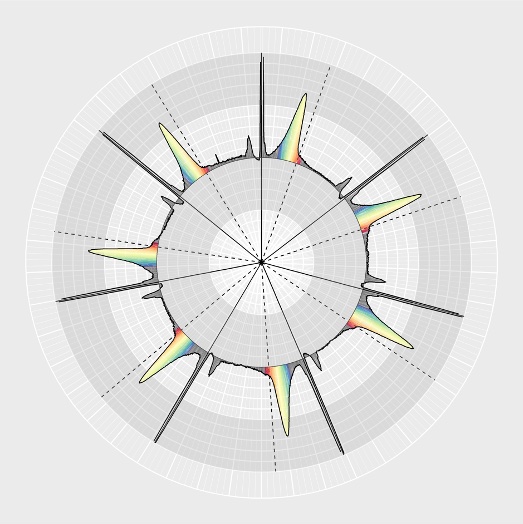
We are currently adapting the approach to work for other heart conditions, and in particular heart attacks. A key motivation is improving early detection for women, as they experience different symptoms to men and are more likely to have a delayed diagnosis.
 ECG-X
ECG-X 